You get in the car, and twenty minutes later you are parked at home with no memory of the drive. You did not decide to change lanes, brake, or turn — it just happened. That eerie autopilot is one of the clearest windows into how the brain forms habits: it quietly converts actions you once thought about into routines it can run without you. Understanding that process is the difference between fighting your habits and finally using them.
This guide covers how habits are built. If you are trying to change one you already have, read how to break a habit instead.
In this article:
- What a habit really is
- Habit or decision?
- The habit loop: how the brain forms habits, step by step
- Inside the brain: the basal ganglia takeover
- Dopamine: the craving that drives repetition
- Chunking: how the brain compresses a routine
- How long does it take to form a habit?
- How to use habit formation to your advantage
- FAQ
What a Habit Really Is
A habit is a behaviour that has become automatic through repetition — something you do with little or no conscious thought. The American Psychological Association defines it as a well-learned response performed automatically in a particular situation. The key word is automatically. A habit is not simply a behaviour you repeat; it is one the brain has handed off to a lower-effort system so your conscious mind can be somewhere else. That hand-off is the whole story of how the brain forms habits.
Habit or Decision?
Repetition alone does not make a habit. What matters is what the behaviour is now responding to.
Researchers draw a line between goal-directed action and habitual action. A goal-directed action is performed because you currently want the outcome; devalue the outcome and the behaviour stops. A habitual action is performed because the situation triggered it, and it keeps running even when the outcome is no longer worth much. Wendy Wood and Dennis Rünger’s review in the Annual Review of Psychology treats this as the defining property: habits are cued by context, and they are the brain’s efficient default rather than a separate kind of intention.
This is why “I do it every day” and “it is a habit” are not the same statement. Something you repeat daily because you decide to each morning is still a decision. It becomes a habit when the cue does the work and the decision drops out.
The Habit Loop: How the Brain Forms Habits, Step by Step
Decades of behavioural research describe habit formation as a three-part loop:
- Cue — a trigger that tells the brain to start (a time, place, feeling, or preceding action).
- Routine — the behaviour itself.
- Reward — the payoff that tells the brain the loop is worth remembering.
Repeat that sequence enough and a fourth element appears: craving. The brain starts to anticipate the reward when it detects the cue, and that anticipation — not the reward itself — is what pulls you into the routine. This is why a notification sound can trigger the urge to check your phone before you have decided anything. The reward learning here is a form of reinforcement: behaviours that pay off get wired in.
Inside the Brain: The Basal Ganglia Takeover
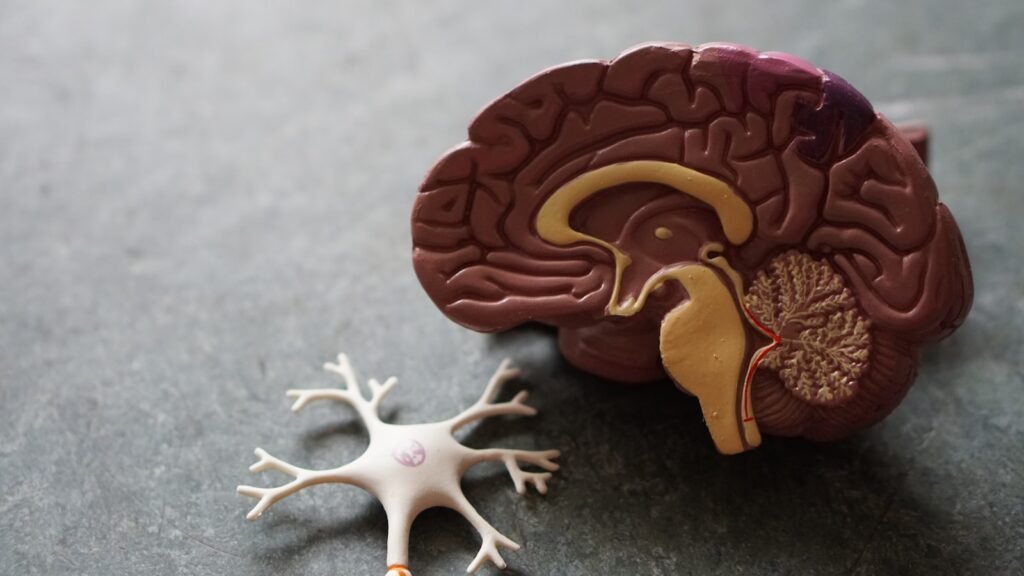
When a behaviour is new, it leans heavily on the prefrontal cortex — the brain’s slow, effortful decision-maker. As you repeat it, control migrates to a set of deep structures called the basal ganglia, which specialise in automatic, learned routines. Neuroscientist Ann Graybiel and colleagues at MIT have shown in animal studies that as a routine becomes habitual, activity in these circuits reorganises and the behaviour runs with far less top-down effort — research summarised in her work on habits, rituals, and the evaluative brain. In plain terms: the brain forms a habit by moving it out of the expensive thinking department and into the cheap automatic one.
That efficiency is a feature, not a bug. It frees your conscious mind for new problems, and it is one concrete example of what neuroplasticity actually looks like in practice rather than in slogans. It is also the reason a habit is hard to remove later — the routine does not get deleted, only overridden. The same automation quietly powers many cognitive biases that run before conscious thought.
Dopamine: The Craving That Drives Repetition
The chemical that cements the loop is dopamine. It is widely misunderstood as a simple pleasure chemical, but research suggests it functions more as a prediction and motivation signal. Early on, dopamine rises when the reward arrives. As the habit forms, that response shifts earlier — to the cue that predicts the reward. That shift is the neurological signature of a craving, and it is why the pull to act can feel strongest before you have done anything. Habit formation, at the chemical level, is your brain learning to want the cue.
Chunking: How the Brain Compresses a Routine
There is one more trick behind how the brain forms habits: chunking. A complex sequence — unlock phone, open app, scroll, tap — gets bundled into a single automatic unit. Once chunked, the whole routine fires from one cue, like a single domino knocking over a pre-arranged chain. This is why habits feel effortless, and why they are hard to interrupt midway: you are not running ten decisions, you are running one compressed program.
How Long Does It Take to Form a Habit?
You have probably heard “21 days.” That number is a myth with no solid evidence behind it.
The most careful real-world study is Lally and colleagues (2010), who tracked 96 people building an everyday eating, drinking, or activity habit in a fixed daily context over 12 weeks. Time to reach near-maximum automaticity ranged from 18 to 254 days, with a median of 66. More complex behaviours took longer.
Two details of that study get lost in the headline. Roughly half the participants never reached automaticity within the window at all — so 66 days is the median among those who got there, not a general guarantee. And missing a single day did not measurably damage the process. What mattered far more than perfection was consistency of the cue. Miss a day here and there and habit formation still proceeds; change the context constantly and it stalls.
How to Use Habit Formation to Your Advantage
Once you know how the brain forms habits, you can work with the machinery instead of against it:
- Anchor a clear cue. Attach the new behaviour to something that already happens reliably — “after I pour my morning coffee, I read one page.” A stable cue is the single biggest predictor of whether a habit sticks.
- Make the routine tiny. A behaviour small enough to feel trivial still installs the loop through repetition. Consistency builds the chunk; intensity does not.
- Guarantee an immediate reward. The brain wires in what pays off now, so give yourself a small, instant sense of completion.
- Keep the context stable. Same place, same time, same trigger. Novelty is the enemy of automaticity while a habit is still forming.
- Expect months, not weeks. Judge progress by whether the behaviour is getting easier to start, not by whether you have hit a day count.
Working with the loop is one of the most practical mental models for lasting change, and it explains why real transformation usually comes from redesigned routines rather than a burst of motivation — a theme we explore in why motivation does not last.
Changing a habit you already have is a different problem with a different evidence base. That is covered in the companion guide on how to break a habit.
FAQ
How does the brain form a habit, in one sentence?
By repeating a cue-routine-reward loop until the behaviour is chunked and handed off from the effortful prefrontal cortex to the automatic basal ganglia, with dopamine wiring in the craving that starts the loop.
Is 21 days really enough to build a habit?
No — the “21 days” claim has no solid scientific basis. The best real-world data found a median of 66 days with a range of 18 to 254, and only about half of participants reached automaticity at all within 12 weeks.
What is the difference between a habit and a routine you repeat?
A routine you repeat is still a decision if you choose it each time. It becomes a habit when the context triggers it and the decision drops out — which is also when it continues even after the payoff stops being worth much.
Does missing one day ruin habit formation?
No. In the Lally study, missing a single opportunity did not materially affect the process. Sustained changes of context are far more disruptive than an occasional gap.
What are some habit loop examples?
Phone buzzes (cue) → you check it (routine) → something mildly interesting (reward). You sit in the car (cue) → you put on the same playlist (routine) → the drive feels shorter (reward). You finish dinner (cue) → you open the fridge again (routine) → a small hit of something sweet (reward). In each one the cue is a situation rather than a decision — which is why noticing your own cues is more useful than counting your own willpower.
Want one sharp, science-backed idea about the mind each week? Join the Mind After Dark newsletter — no noise, unsubscribe anytime.