
Ask almost anyone who has watched a friend endure a cruel partner, a soul-draining job, or a manipulative “best friend,” and you’ll hear the same bewildered question: Why don’t they just leave? The answer matters, because understanding why good people stay in toxic situations is the first step to helping them—or yourself—get out. Staying is rarely about weakness, low intelligence, or bad character. It is the predictable result of how the human brain handles attachment, uncertainty, and pain. Once you see the machinery, the choices that once looked baffling start to make painful sense.
This article breaks down the psychology, neuroscience, and cognitive science behind staying—and, more importantly, gives you practical tools to think more clearly and reclaim your judgment.
Table of Contents
What Makes a Situation “Toxic” — and Why Smart People Miss It
A toxic situation is any relationship, environment, or dynamic that repeatedly damages your wellbeing while offering just enough reward to keep you hooked. It might be a romantic relationship marked by control and contempt, a workplace that runs on fear, or a friendship that leaves you drained every time. The defining feature is a pattern: harm followed by relief, criticism followed by warmth, chaos followed by calm.
Intelligent, kind, self-aware people miss these patterns for a simple reason—toxicity rarely arrives all at once. It escalates gradually, and each small step feels survivable. By the time the situation is clearly harmful, the person is already deeply invested and their sense of what’s “normal” has quietly shifted. Recognizing subtle red flags, from gaslighting to everyday manipulation tactics, is far harder from the inside than from the outside.
Toxic Isn’t Only Romantic: Jobs, Friendships, and Families
When we talk about why good people stay in toxic situations, most people picture a bad romantic relationship. But the same psychology plays out at work, in friendships, and inside families. The employee who stays years past burnout because leaving feels like admitting failure. The friend who keeps showing up for someone who only ever takes. The adult child who absorbs a parent’s contempt because “that’s just how they are.” The specific stage changes, yet the underlying script is remarkably consistent: intermittent reward, escalating investment, shrinking perspective, and a slow rewrite of what counts as normal.
This matters because people often give themselves permission to leave one kind of toxic situation while staying trapped in another. Recognizing that the same forces operate everywhere makes the pattern easier to spot—and easier to forgive in yourself.
Why Good People Stay in Toxic Situations: 6 Psychological Traps
There is no single reason why good people stay in toxic situations. Instead, several powerful psychological forces usually stack on top of one another, each one reinforcing the others. Here are the six that research points to most consistently.
1. Cognitive Dissonance: Your Mind Rewrites the Story
Psychologist Leon Festinger’s theory of cognitive dissonance describes the discomfort we feel when our actions and beliefs collide. If you believe you’re a smart person who would never tolerate mistreatment, yet you are tolerating it, your brain faces an intolerable contradiction. Rather than change the behavior—which feels overwhelming—the mind often changes the story instead: “It’s not that bad.” “They only act this way because they’re stressed.” “Every relationship has problems.”
This is the same self-protective machinery behind the many small ways we lie to ourselves. Dissonance reduction feels like relief in the moment, but it quietly rewrites your perception until the abnormal looks ordinary. That’s why people can defend a situation that horrifies everyone around them—their brain has been working overtime to make the contradiction disappear.
2. Trauma Bonding: The Intermittent-Reward Trap
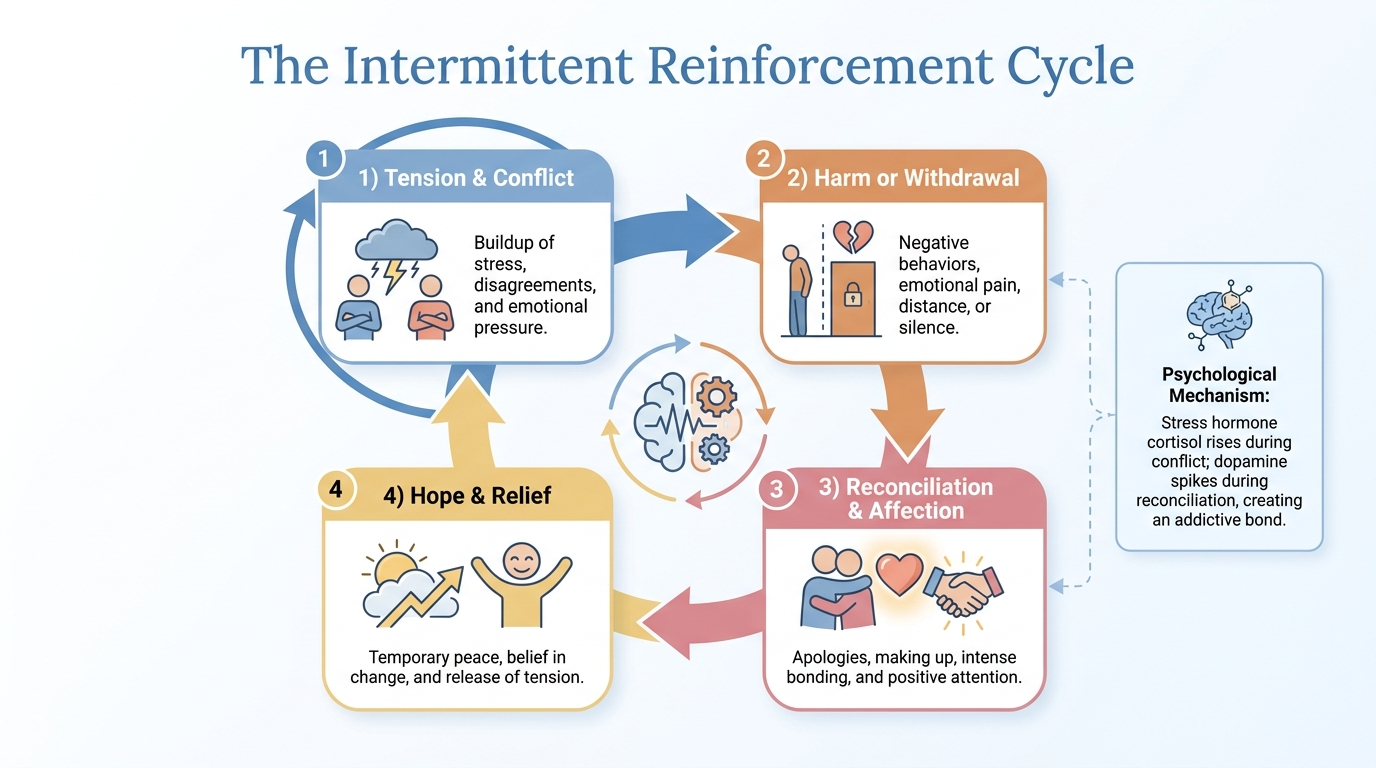
One of the most powerful reasons people stay is intermittent reinforcement—the unpredictable alternation of cruelty and kindness. When affection, apologies, and promises are handed out sporadically between periods of harm, the brain becomes fixated on chasing the next “good” moment. Neurologically, the stress of conflict floods the body with cortisol, and the relief of reconciliation releases dopamine. That cortisol-then-dopamine cycle can feel almost chemically addictive.
This dynamic, often called a trauma bond, exploits the same reward circuitry that drives gambling. It’s worth understanding how your attachment style shapes vulnerability here, and why calm, consistent connection can even feel unfamiliar—one reason some people report that healthy relationships feel boring at first. The unpredictability isn’t a bug the victim fails to notice; it is precisely what makes the bond so hard to break.
3. The Sunk Cost Fallacy: “I’ve Invested Too Much to Leave”
The sunk cost fallacy is the tendency to keep investing in something because of what we’ve already put in—time, money, years, identity—even when the evidence says walking away is wiser. Ten years of marriage, a decade climbing the same career ladder, or a friendship dating back to childhood all create an emotional ledger that feels reckless to abandon.
Underneath sits loss aversion: research consistently shows that losses tend to hurt more than equivalent gains feel good. Leaving is framed by the brain as a loss of everything invested, while staying is framed as protecting it. The cruel twist is that the longer you stay, the larger the “sunk cost” grows, and the harder leaving becomes. This is just one of many cognitive biases that quietly steer decisions we think are rational.
4. Learned Helplessness: When Escape Feels Impossible
When people try to change a bad situation repeatedly and nothing works, they can slide into a state psychologists call learned helplessness—a deep belief that action is pointless. For decades this was thought to be a learned response to lack of control. Strikingly, a 2016 reappraisal by Steven Maier and Martin Seligman, “Learned Helplessness at Fifty,” revised the theory using neuroscience: passivity and shutting down appear to be the default mammalian response to prolonged stress, mediated by serotonin circuits in the brainstem. What we actually learn is the opposite—a sense of control, driven by the prefrontal cortex, that switches the passivity off.
The practical takeaway is hopeful: helplessness isn’t the truth about your situation. It’s a physiological state that can be interrupted by regaining even a small, genuine sense of control. That single insight—that the shutdown is a default to be switched off rather than a verdict to be accepted—is often the doorway out.
5. Fear of the Unknown and the Comfort of the Familiar
A painful situation you understand can feel safer than an uncertain future you can’t predict. The brain is a prediction machine, and it treats the familiar—even when it hurts—as lower risk than the unknown. Add realistic fears about finances, housing, children, safety, or loneliness, and the perceived cost of leaving can loom far larger than the daily cost of staying.
6. Identity and Belonging: “Who Am I Without This?”
Long-term situations become woven into our sense of self. A person may define themselves through their marriage, their loyalty, their role as the dependable employee, or their status within a group. Leaving can feel like erasing part of who they are. For many, the fear isn’t only losing the situation—it’s losing their identity, their community, and their story about themselves.
The Neuroscience: Why Your Brain Defaults to Staying
Zoom out, and a clear picture emerges. The brain is wired to conserve energy, avoid loss, maintain attachment, and prefer predictable pain over unpredictable change. Under chronic stress, the thinking, planning prefrontal cortex—the part you’d need to weigh options and make a change—becomes less dominant, while older survival circuits take the wheel. That is a recipe for freezing in place.
None of this means a person is broken or foolish. It means their nervous system is doing exactly what it evolved to do: keep them attached and minimize sudden loss. Understanding why good people stay in toxic situations as a brain and body response, rather than a character flaw, removes the shame that so often keeps people stuck and silent.
How to Think More Clearly and Reclaim Your Judgment
Clarity doesn’t arrive in a single lightning bolt of realization. It’s rebuilt in small, deliberate steps that loosen the grip of these psychological traps. Here is a practical framework.
Name the pattern out loud. Vague discomfort keeps you stuck; specific language sets you free. Write down concrete incidents with dates rather than general impressions. Naming cognitive dissonance, a trauma bond, or a sunk cost for what it is strips away some of its power and reengages the rational brain.
Run a “future cost” test. To defuse the sunk cost fallacy, stop asking “How much have I already invested?” and start asking “Knowing what I know now, would I choose to enter this situation today?” The past investment is gone either way. The only question that matters is what the next year will cost you.
Rebuild outside input. Toxic situations shrink your world and make your own perception the only mirror you have. Deliberately widen it. Trusted friends, a therapist, or even a written journal act as a reality check against the story your dissonance is quietly rewriting.
Restore a small sense of control. Because helplessness is interrupted by regained control, take one concrete, achievable action—open a separate bank account, update your resume, book a single consultation, attend one support meeting. Small wins signal to the brain that action is possible again, weakening the passivity response.
Set and hold one boundary. You don’t have to overhaul everything at once. Practicing a single clear limit—and noticing the reaction it provokes—is often revealing. Learning the fundamentals of setting boundaries gives you both information and self-respect to build on.
When to Seek Professional Help
Self-awareness is powerful, but some situations call for more support than a framework can provide. If you’re experiencing abuse, threats to your safety, deep depression, or a sense that you simply can’t think your way out, please reach out to a licensed mental health professional or a trusted support service. Trauma bonds and chronic stress can be genuinely difficult to unwind alone, and asking for help is a sign of strength, not failure. In any situation involving danger, prioritize your immediate safety and contact local emergency services or a dedicated helpline.
Frequently Asked Questions
Why do good people stay in toxic situations even when they know it’s bad?
Knowing something intellectually and being able to act on it are different processes in the brain. Cognitive dissonance, trauma bonding, sunk cost, and chronic-stress-driven passivity can all override rational awareness. Staying despite “knowing better” is common and doesn’t mean a person is weak or foolish.
Is staying in a toxic relationship a sign of low self-esteem?
Not necessarily. While self-esteem can play a role, confident and accomplished people stay too. The forces at work—attachment chemistry, loss aversion, and identity—affect nearly everyone. It’s better understood as a universal psychological vulnerability than a personal failing.
What is the difference between a trauma bond and love?
Love tends to be steady, safe, and mutually respectful. A trauma bond is fueled by the highs and lows of intermittent reinforcement—intense attachment that grows because of the cycle of harm and relief, not despite it. If the intensity depends on chaos, that’s a warning sign.
How do I start leaving a toxic situation?
Begin small: name the pattern in writing, restore outside perspective, take one concrete action that increases your independence, and hold a single boundary. Momentum builds from small wins. For safety-sensitive situations, involve a professional or support service before making major moves.
Conclusion
Understanding why good people stay in toxic situations transforms a question loaded with judgment into one grounded in compassion and science. Staying is not a character defect—it’s the outcome of cognitive dissonance, trauma bonding, sunk cost, learned helplessness, fear, and identity all pulling in the same direction. The encouraging truth is that every one of these traps has a counter-move. By naming the pattern, testing your reasoning, widening your perspective, and reclaiming small pieces of control, you can quiet the brain’s default toward staying and think clearly enough to choose something better. Clarity is a skill—and like any skill, it can be learned.